Image Consumer (C++)
Architecture
MediaPipe4U vision tasks continuously process frames from an image source. MediaPipe4U combines multiple AI and AR technologies, such as Google MediaPipe and Nvidia NvAR, most of which consume image frames for computation. MediaPipe4U uses a publish/subscribe (PUB/SUB) pattern to deliver images to these technologies and integrate their vision processing.
For image sources, read Image Source.
A simple workflow is shown below:
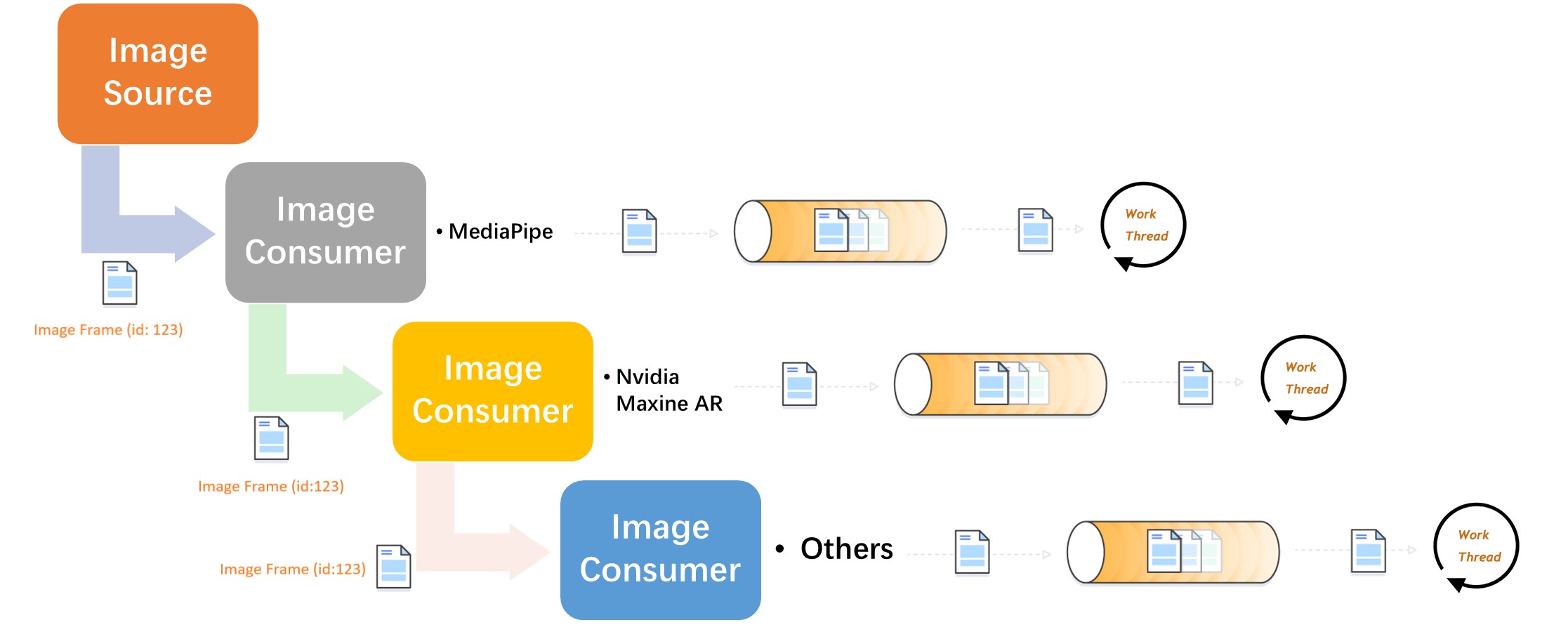
All ImageConsumer instances consume the same frame and run serially. This simplifies low-level thread management and reduces memory copying.
Consequently, an ImageConsumer must not consume an image synchronously, because synchronous consumption blocks the next Consumer from receiving the frame.
Tip
Recommended ImageConsumer pattern: buffer a queue. When a frame arrives, simply Enqueue it, then Dequeue and consume it in a background-thread loop or in a UE component's Tick event.
ImageFrame Lifecycle
All consumers share the same frame, reducing memory copies and improving efficiency, but the frame must be released at the correct time.
Pooling
ImageSource maintains a frame-object memory pool. After all consumers finish, the frame returns to the pool and its memory can be reused, reducing frequent allocation and release.
When other idle frames remain in the pool, a slow consumer does not prevent other consumers from processing in parallel.
Warning
If an ImageConsumer holds a frame for a long time because Consume does not return, the ImageSource pool fills up. With no free memory, ImageSource stops distributing frames.
Implement IImageConsumer in C++
MediaPipe4U abstracts an ImageConsumer as a C++ interface, not an Unreal Engine interface and therefore unavailable in Blueprint. Implement it to integrate image-processing functionality with MediaPipe4U.
class IImageConsumer
{
public:
    virtual ~IImageConsumer() = default;
    virtual  bool CanConsume() = 0;
    virtual bool Consume(const FImageSourceInfo& SourceInfo, const TSharedPtr<IMediaPipeTexture>& Texture) = 0;
};
IImageConsumer functions:
| Function | Description | Notes |
|---|---|---|
| CanConsume | Returns true when frames can be consumed, causing ImageSource to call Consume. Returns false when this Consumer does not accept frames. | Return false to effectively turn consumption off. |
| Consume | Consumes an image frame. Parameters: SourceInfo: image height, width, format, and other information;Texture: pointer to the frame and its byte-array data. |
 Note: Note:Do not implement Consume synchronously. Blocking the current thread prevents other Consumers from receiving frames. |
SourceInfo and Texture are read-only and must not be modified.
SourceInfo stores frame information; Texture stores frame data.
SourceInfo Structure
struct FImageSourceInfo
{
    int Width = 0;
    int Height = 0;
    int WidthStep = 0;
    MediaPipeImageFormat Format = MediaPipeImageFormat::UNKNOWN;
    bool bIsStatic = false;
    int CvMatType = 0;
    int NumOfChannels = 0;
    int ByteDepth = 0;
};
| Property | Description |
|---|---|
| Width | Image width in pixels. |
| Height | Image height in pixels. |
| WidthStep | Row-data stride. MediaPipe4U ImageSources use no byte alignment, so it can be treated as Width * NumOfChannels. |
| Format | Format. For UE compatibility, MediaPipe4U currently uses RGBA and BGRA, although the enum defines all MediaPipe-supported formats. |
| IsStatic | Whether the frame is static: static frames come from images; non-static frames come from video streams. |
| CvMatType | Useful for OpenCV integration; currently only CV_8U. |
| NumOfChannels | Number of image channels. |
| ByteDepth | Bit depth. |
This information lets other image structures such as cv::Mat and NvImage be filled directly without copying memory.
IMediaPipeTexture Interface
IMediaPipeTexture is a simple image-data interface compatible with most popular image-processing libraries. GStreamer, OpenCV, and NvImage integrations are built in.
class IMediaPipeTexture
{
public:
    virtual ~IMediaPipeTexture() = default;
    virtual long GetImageId() const = 0;
    //get uint8*
    virtual void* GetData() const = 0; // currently only a uint8 array
    virtual void Release() = 0;
    virtual long DataSize() const = 0;
};
| Function | Description |
|---|---|
| GetImageId | Frame ID used internally by MediaPipe4U. Because frames are pooled, IDs repeat and are not unique image identifiers. |
| GetData | Array containing image data; currently only uint8. |
| DataSize | Image-data size in bytes: num * sizeof(uint8). Because only uint8 data is used, this also equals GetData.Num(). |
| Release | Never call this method. It returns memory to the pool. An Image Consumer does not manage the IMediaPipeTexture lifecycle. |
Register and Unregister
After implementing IImageConsumer, register it with the MediaPipe4U vision workflow through FImageWorkflow::RegisterConsumer.
FImageWorkflowis a singleton. Obtain its sole instance through staticGet.
TSharedPtr<IImageConsumer> yourInstance = MakeSharedable<IImageConsumer>(new YourImageConsumerClass());
FImageWorkflow::Get().RegisterConsumer(yourInstance);
Unregister it when it is no longer needed:
Alternatively, return false from
CanConsumeto stop it.
Warning
When a Consumer no longer needs frames, unregister or stop it to improve performance.
Integrate with UObject
Because Unreal Engine UInterface participates in garbage collection, IImageConsumer is not a UE interface. MediaPipe4U provides an Unreal Engine wrapper interface for integration with Components and Actors:
UINTERFACE()
class UImageConsumerProvider : public UInterface
{
    GENERATED_BODY()
};

/**
 *
 */
class MEDIAPIPE_API IImageConsumerProvider
{
    GENERATED_BODY()
public:
    virtual IImageConsumer* GetImageConsumer() = 0;
};
Its single pure virtual C++ function returns your IImageConsumer implementation.
This wrapper must also be implemented in C++. Blueprint is unsupported because image processing affects the stability and performance of the entire MediaPipe4U pipeline.
A Component can implement both
IImageConsumerandIImageConsumerProvider, returning this fromGetImageConsumerto wrap a UE component.
NvAR provides an example:
//.h
UCLASS(BlueprintType)
class MEDIAPIPENVAR_API ANvARLiveLinkActor : public AActor, public IImageConsumer, public IImageConsumerProvider

//.cpp
IImageConsumer* ANvARLiveLinkActor::GetImageConsumer()
{
    return this;
}
RegisterConsumer and UnregisterConsumer on FImageWorkflow also accept IImageConsumerProvider.
Warning
When using IImageConsumerProvider, take care with UE garbage collection. If the implementation is a UComponent, consider AddToRoot to prevent collection.
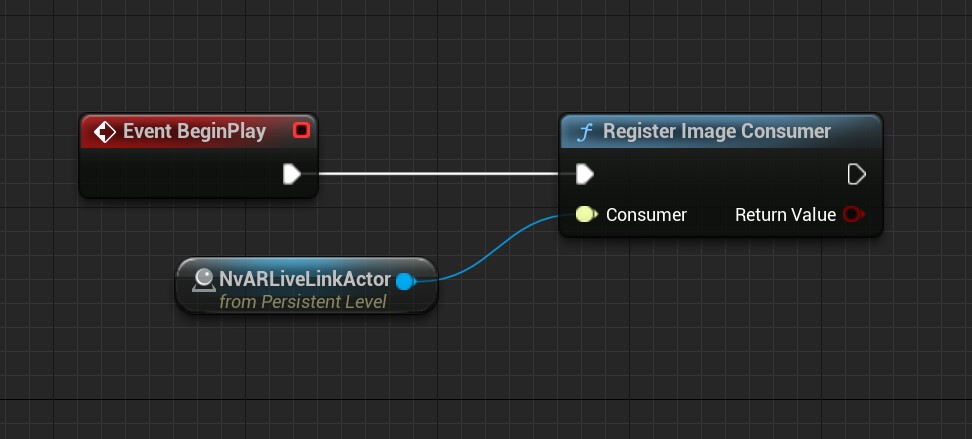
Because IImageConsumerProvider is an Unreal Engine interface, register it through C++ or through the MediaPipe4U Blueprint function library.
Blueprint function names:
- RegisterImageConsumer
- UnregisterImageConsumer